Learn From Our Project
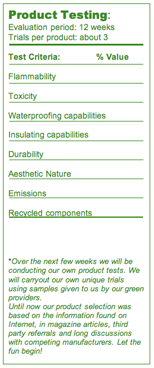
There are many different processes that can be implemented when developing a green home. Common sense has led us to make informed decisions that we believe (after countless hours of research), will allow our home to be self-sustainable.
Green Providers = Green Partners
We believe that the changes that we make to our lives will make an impact in preserving our environment. We suggest that you spend time researching the type of home that you plan to build. Never take the first solution simply because it is the easiest, this often winds up being the most expensive, overly time-consuming, and not the most eco-friendly.Our experiences will help point you in the right direction. The suppliers, products and systems that we will employ have been thoroughly researched on the basis that they will provide us with the most eco-friendly solution for our budget. We live in the real world and do not have an infinite amount of cash to spend! You do not need to be wealthy to be green. Follow our progress and we will show you how a typical couple can build the home of their dreams and be green without breaking the bank.
- Copyright 2015 © GreenLogHome. All rights reserved. • Privacy Policy • Terms Of Use •
Do you know of a Green Product for our project?
We have done a lot of research about Green Materials to ensure we are using sustainable green products. There is such a vast amount of new green products that it would be impossible for us to know them all. We are constantly learning about new products. If you know a product, or make a product that is truly green, eco-conscious, and it fits our specific green criteria, send us an email. The only way for Green products to grow and become more financially attainable in the mainstream is to get them out there. We would love to hear from you.
- Copyright 2015 © GreenLogHome. All rights reserved. • Privacy Policy • Terms Of Use •
Geothermal - WaterFurnace International
The heating, air-conditioning and hot water for our home will be driven by a closed-loop geothermal system. By drilling a couple of holes approx. 250 ft deep, the WaterFurnace 'Envision' systems harnesses the heat energy from the ground. This is achieved through an all-in-one unit that utilizes an ozone-free refrigerant to convert the geothermal heat into on-demand heat, hot water and air-conditioning.
We chose this system because not only does it use significantly less electricity to run the unit (up to 70% less electricity needed compared to heat and gas). but also it is very quiet and does not expel any carbon monoxide as a by-product. Making a very energy efficient device, that aids in providing good indoor air quality too.
www.waterfurnace.com
- Copyright 2015 © GreenLogHome. All rights reserved. • Privacy Policy • Terms Of Use •

Fixtures, Fittings, and Appliances
If you have not heard of Green Demolitions yet, you have now, and when you see what they do, you will never forget them. While researching green compaines to work with on the outfitting of our home we came across them. A non-profit company, Green Demolitions recycles kitchens and bathrooms. Sounds strange, we dont mean recycle as in destroy, we mean to take in donations and then sell the donated items. Proceeds go to All Addicts Anonymous to help people overcome many of lifes unpredictable addictions.
What can you expect to find in any of their 3 showrooms? When we walked around the Bethel NY store, we were simply blown away. The kitchen selection was great, we bought ours within two days of seeing it. They sell a wide range of high end appliances. Brands such as Viking, Sub-Zero, GE, Miele are just a few that you can expect to find. Many of these items are new and come with warranty, they are simply factory surplus. For you the consumer, get ready to buy, all items are 50 to 75% off retail. A Viking refrigerator brand new can be purchased for $1200. amazing
As their tag line says, "Do good, Save more", really does apply in all cases. you get a stylish new kitchen, the landfills see less materials thrown away, and you help people to recover from addiction. Truly a win win situation.
For those of you who would like to donate, you get a tax deduction for the valued amount. If you are planning to renovate your home, why throw away anything, you simply call Green Demolitions and talk to them. They will come and carefully remove your old kitchen and bring it to the showroom. You save on the cost of demolition and the cost of bringing it to a landfill, plus get a tax break. What could be better.
If you would like to donate or learn about it more please call 888-887-5211 or email: donations@greendemolitions.org
www.greendemolitions.com
- Copyright 2015 © GreenLogHome. All rights reserved. • Privacy Policy • Terms Of Use •
Log Home - Moosehead Cedar Log Homes
We decided to go with MCLH for several reasons:
One of our aims is to work with companies whose products and services play a part in preserving and maintaining our environment. MCLH fulfilled our criteria. We learned that MCLH are part of a renewable forestry program that ensures for every tree cut down and used in construction of a log home, two others are planted in its place. This helps promote good forestry practices.
Another reason we opted for White Cedar is that unlike Pine, it does not require the energy intensive kiln drying process to prepare the log. White Cedar is a much more resilient wood and is not prone to insect infestation. It doesn't require the use of harmful chemicals to protect and seal it. White Cedar logs also possess a greater thermal mass than pine. This in a nutshell means that once built, the White Cedar log home will have a much greater resistance to heat loss than pine.
Something that should never to be overlooked is knowledgeable staff. We had many questions and alterations to our floor plans. Everyone we have dealt with knew the product well so modifications were painless. Many log home companies have a "salesman mentality" which makes it all impersonal. MCLH never made us feel like a number, more like a partner in the building process.
www.mclh.net
- Copyright 2015 © GreenLogHome. All rights reserved. • Privacy Policy • Terms Of Use •

Metal Roofing - MBCI
We have decided to opt for a metal roof for several reasons: Firstly the roof consists of recycled steel, thereby reusing materials, conserving natural resources (apparently for Every ton of steel recycled, 2,500 pounds of iron ore, 1,400 pounds of coal, and 120 pounds of limestone are saved!!) Secondly, metal roofs do not require replacing every 8-12 years compared to conventional roofing materials. A new metal roof will be the last roof we ever need to install. It requires low maintenance and in the long run saves time and money. Our specific roof is Energy Star rated and will add to our homes overall efficiency.
www.mbci.com
- Copyright 2015 © GreenLogHome. All rights reserved. • Privacy Policy • Terms Of Use •

Stain - Sashco
We want to preserve our log home for many years to come. Choosing the right stain and sealant is essential for years of maintenance-free living. We are currently restoring the Green Log Home and Dream House Log Cabin with Sashco Transformation Stain. Our original stain and caulk, made by Sansin, failed prematurely. After having spent a lot of time researching different companies and their products, we chose 'Sashco Transformation' to restore and bring the beauty back to our cedar log home.
Sashco makes an array of color choices in their stains. We have opted for Dark Tone Brown, to us it is a natural looking wood compared to the orange color that we see on so many log homes. As part of our log home restoration we are also using 'Sashco Conceal' to fill all upward facing checks, open gaps and butt joints. Our original caulking (also made by Sansin) did not stretch as the logs shrunk; leading to a seal failure around the home resulting in heat loss. We are delighted that not only is Conceal able to take the stain color of the house to blend in; it is very elastic and will stretch for years to come as the house moves (all log homes move). As a point of reference, a one inch circle when dried will stretch to 6 inches!! Our Sansin caulk barely stretched half an inch, thus the early failure. We are excited to say that Sashco products will be used to keep the Green Log Home looking great for years to come. We are nearly complete with the restoration and will be sharing some pictures of the process.
If you are looking to refinish your log home and minimize log maintenance, look no further than Sashco products.
www.sashco.com
- Copyright 2015 © GreenLogHome. All rights reserved. • Privacy Policy • Terms Of Use •

Windows - Pella
Pella Windows will play a major part of our ecological green log home. They will be used to demonstrate to the audience how proper insulation, through the selection of energy efficient windows will save money by lowering heating and cooling bills. Thereby ultimately reducing energy consumption and minimizing waste and pollution derived from the burning of fossil fuels.
Pella produces a wide range of different windows. We will be using energy-saving; argon-gas filled, Low-E glass, triple-pane options with between-the-glass blinds to further increase energy savings and incredibly even reduce outside noise - like lawn mowers and traffic - by up to 80%.
www.pella.com
- Copyright 2015 © GreenLogHome. All rights reserved. • Privacy Policy • Terms Of Use •
Frequently Asked Questions
Compared to homes built in a traditional way, how strong is a green log home during extreme climatic conditions such as hurricanes, earthquakes etc..?
Log homes are strong, solid structures. The logs are designed and cut with locking corners to maintain maximum energy efficiency and water resistance/penetration in mind. The solids logs link together perfectly and are milled with a precision fit. Their own weight, combined their solid nature makes them naturally a very strong configuration, ready to stand against extreme weather conditions. Traditional construction uses conventional 'stick and frame' elements, these consist of multiple components that require attaching together, leaving room for exposed seams.
Is it possible to build a green log home that complies with the neighborhood zoning?
Log homes have traditionally been built from natural materials and generally fit into a more natural environment, but not on a suburbia street! Zoning requirements will identify the acceptable structures for your area. Log homes are the most natural, environmentally sustainable and organic homes that have ever been made and will be continue to be made.
Will the green log home provide a healthier living environment than conventional homes?
Logs are naturally occurring materials. They do not omit VOCs. Natural cedar wood doesn't require kiln drying to kill any insect infestation it also doesn't require harsh stains to repel insects.
What is MCLH (our log home provider) doing to reduce the impact of global warming on the environment?
They are part, and have been for a while participating in several forest management programs, they also work with 'green builders', and partnering with manufacturers whose products don't emit VOCs, and which use recyclable materials etc..
How does a green log home impact/preserve the planet?
We all need to play a part in reducing global warming. By creating a green home we can make all make an impact in reducing carbon dioxide levels from the burning of fossil fuels, saving our planet for future generations. Renewable, clean energy is plentiful. If every individual took advantage of green practices in their homes, we can help to reduce the increase of extreme weather changes, flooding and the impact on our environment.
With the increasing number of pollutants in our environment does it make sense to build an individual green log home?
Yes, if the home is constructed following green building practices it promotes healthy living and encourages sustainability. A tie-in into the electricity grid allows all clean energy not used to be to be sold and used by other individuals, businesses and industry.
Isn't 'being green' just the newest green-washing marketing technique used to sell products? How do we know if companies claiming to be green are the real deal?
Sustainability is our real goal; many use the term 'green' to push products and services that aren't really green. We hope to expose those people while we build our home. We hope to provide consumers with enough information to make their own informed decisions and learn how to live a sustainable lifestyle. Our log home provider MCLH was established many years ago, before any 'green-washing' techniques were invented. Many of the same practices and processes that are considered green today have been in place since the beginning. All of our other materials have been thoroughly researched and we are looking for sustainable practices in the creation of their products.
With all the recent 'green-washing' are Americans buying more green products?
There is an increased awareness about the environmental issues that we face. Studies conducted by Intellitrends, indicate that by the end of 2007, over half of the US population had read an article regarding the environment. Fewer than 50% of the population had seen a TV program with some 'Green' content. The purchase of 'Green' products went up by 22% from mid-2007 to year-end. People are starting to listen, learn and change their behavior. Many companies are profiteering from this. We will help differentiate fact from fiction!
Our log home provider (MCLH) has been selling consistently to people wishing to build their dream home, independent of whether there exists any green hype or not!
Why are MCLH log homes unique compared to others?
We are working with the best materials, designers, architects at MCLH and they have involved us every step of the way. We also made sure that we talking about costs during every step of the process, ensuring that we remained within our budget.
With all the recent fires in California and the high numbers of homes at risk, aren't wooden logs putting your home at greater risk of incineration, especially since green materials these days are becoming more fire resistant?
No, logs don't burn easily, compared to timber framed homes. Their solid mass is significantly less combustible compared to traditional stick and frame/timber home building materials. We are also implementing a sprinkler system too. Did you know that if you home is located near a lake, the cost of insurance is reduced where fire is concerned?
Why do people buy traditionally built stick and frame or timber homes when a green log home will save on monthly bills (due to better thermal insulation and use of clean energy) and is healthier and has a better resale value?
People choose homes to blend in with the nature around and their own dream. A log-home may not be appropriate for suburban areas. There are many log home companies out there, that don't provide complete packages nor do they work closely with the budgets of their customers. Like everything in life, we all prefer different homes and different locations. We feel that log homes blend well into a natural surrounding and we hope to continue the tradition of log home building that has been in place for many years!
Many trees are cut down to build a green log home - how is this practice 'green' or sustainable?
All the wood used and milled for our home comes from forests that promote good management practices, which provide employment and preserve the environment. Many other home manufacturers use building materials whose components require chemicals during their extraction or energy intensive processes to prepare them for the construction process. Log homes are a traditional method of home building, established many years ago, long before synthesized materials were created in bulk.
- Copyright 2015 © GreenLogHome. All rights reserved. • Privacy Policy • Terms Of Use •

PEX Tubing
PEX tubing will be used extensively throughout the project. We chose to use PEX because of its ease of installation and versatile ability. Uponor is committed to environmental conservation through the constant innovation of their product offerings. PEX makes roughing in the plumbing of a house simple and easy. All of our fresh water will be PEX. One really big advantage of PEX vs copper is even in really cold conditions, if the water freezes, PEX expands to almost double its size to acommodate. Traditional copper would expand and burst leaving not only a mess, but a hefty repair bill. Taking things one step further, we will have radiant floor heating throughout the house. Once again PEX makes it simple to install and maintain. Using Uponors track installation not only makes it faster, the metal plate allows for even heat transfer to the floor and less heat loss that tacking it in place. Couple that with a quality control system and you have an amazing system in place that will conserve energy and water while providing the comforts we couldn't live without. To really round out the use of PEX, our house will be protected by a fire safety sprinkler system that will provide peace of mind and lower insurance. If you look through the Uponor website you will find all the products you need to get it done right, the first time around. They even have a CD to guide you through and design a custom system for your project.
www.uponor-usa.com
- Copyright 2015 © GreenLogHome. All rights reserved. • Privacy Policy • Terms Of Use •
- Copyright 2015 © GreenLogHome. All rights reserved. • Privacy Policy • Terms Of Use •
Wind Power
Coming soon
www.greenloghome.com
- Copyright 2015 © GreenLogHome. All rights reserved. • Privacy Policy • Terms Of Use •
Solar Power
Coming soon
www.greenloghome.com
- Copyright 2015 © GreenLogHome. All rights reserved. • Privacy Policy • Terms Of Use •